The National Flag
The Origin of The Stars and Stripes
Flags of the Confederate States
The President's Standard
US States
Other US Flags
Click here to buy an American Flag!
The National Flag
The National Flag of the United States of America, which is also the Ensign and the Merchant Flag, is known as "The Star-Spangled Banner", "Old Glory", or the "Stars and Stripes". The stars, white on blue, in the canton, represent the number of States forming the Union; this is now fifty, in nine alternate rows of six and five. The thirteen red and white stripes in the fly represent the original states from which the Union grew.
The U. S. Jack, sometimes called the "Union" and sometimes even the "Union Jack", is identical with the canton. The Warship Pennant bears seven stars, white on blue, at the head; for the rest of its length it is divided horizontally, red over white, and it ends in a long "swallow-tail".
The display of the Stars and Stripes is strictly regulated by the Flag Code. Except where for special reasons, as at the Capital, it is kept flying day and night, it is flown only during the hours of daylight. Solely as a signal of dire distress is it to be inverted, and no other flag, except during Divine Service, the Naval Church Pennant (a blue Latin Cross placed horizontally on a white field), may be flown above it. When the National flag is ceremonially paraded or hoisted or lowered, all present must face it and stand to attention: those in uniform salute, others place the right hand over the heart, men holding the hat in the right hand. Foreigners, however, should stand to attention. On suitable occasions the Pledge to the Flag is to be repeated:
I pledge allegiance to the Flag of the United States of America and to the Republic for which it stands, one nation under God, indivisible, with liberty and justice for all.
(return to top)
The Origin of The Stars and Stripes
When the American colonists rose in armed protest against the British Government, the emblem they first adopted signified both their unity and the loyalty, which they still retained towards the Mother Country. Their Great Union Flag, also known as the Congress Flag and the Cambridge Flag, bore thirteen red and white stripes, but the contemporary British Union Flag formed its canton. This was similar to the flag of the East India Company, but whether it was deliberately adopted from this is unknown. When, however, the Americans decided on a complete severance from Britain, they needed a new flag to symbolize their independence. While retaining the thirteen stripes in the fly, they replaced the Union in the canton by "thirteen stars white on a blue field representing a new constellation". The exact arrangement of the stars in the first American Flag is uncertain, but it is reputed to have been a circle so that one should have no precedence over the other. Many may refer to this style as the Betsy Ross flag.
Although the original designer of the flag is still unknown, evidence points to New Jersey delegate Francis Hopkinson. Hopkinson is credited with designing the seal of the American Philosophical Society, the New Jersey state seal, as well as seals for various other government departments. He petitioned Congress to be paid for his flag design but was ultimately rejected saying other people helped contribute to the design.
As new States were admitted to the Union, the number of Stars and Stripes was increased accordingly, and during the second Anglo-American war the flag displayed fifteen stars and fifteen stripes. It was the sight of this "Star-Spangled Banner" still flying, after a night's bombardment, over fort McHenry "in the dawn's early light" which led Francis Scott Key to compose what became the National Anthem of the United States. The increase in the number of stripes threatened however to destroy the flag's effectiveness. So, in 1818, congress decided to revert to the original thirteen stripes but to indicate the admission of a new State by displaying an additional white star in the canton.
(return to top)
Flags of the Confederate States
During the Civil War the Southern Confederacy adopted a new flag which, while differing markedly from the Stars and Stripes, still generally resembled it in design. The Stars and Bars bore in its blue canton a circle of seven white stars symbolizing the first States to secede from the Union, but merged the red and white of the fly into a bold tricolor. This flag was found to resemble the Stars and Stripes too closely, and was therefore replaced by an emblem, which retained the traditional American colors but arranged them very differently. The Southern Cross, the Confederate Battle Flag, displayed thirteen white stars on a blue saltire, fimbriated in white, on a red field. As this could not be inverted in case of need as a flag of distress, it later formed the canton of a flag with a white field; then, lest this be mistaken for a flag of truce, a broad red stripe was added down its fly. The original Southern Cross is still used, unofficially, as the "Flag of the South".
(return to top)
The President's Standard
The standard of the President of the United States is dark blue and bears, with in a circle of stars, one for each state, a replica of the design on the Presidential Seal. The American Eagle is shown with its head turned towards its right talon, which holds an olive branch, while the left talon holds a bundle of arrows - the emblems of peace and war. Above and beside the head are thirteen white stars, representing the Founder States of the Union, and a scroll bears the motto E Pluibus Unum, " One out of Many".
|
History of Flags Used in the United States
|
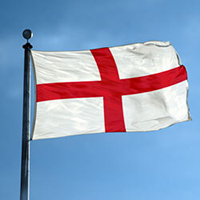 |
St. George Cross Flag
The design a simple red cross on a white background flag was carried to the New World by most of the early English explorers. The design itself has been in use since the crusades and traced back to 1277 in Britain. You can learn more about Saint George for whom the flag is named at Wikipedia. |
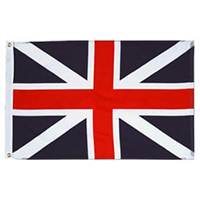 |
The Kings Colors
Used by British colonial troops after 1743 this flag is a combination of the St. George Cross with the Scottish Cross of St. Andrew. This was the standard raised by the Jamestown settlers in 1607. Although very similar this is NOT the current British flag. The current British standard can be found here. |
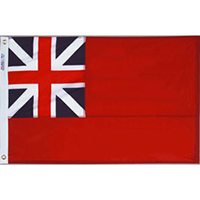 |
British Red Ensign
The Red Ensign or "Red Duster" is a flag that originated in 1707 under the rule of Queen Anne as the English ensign flown by the Royal Navy and later specifically by British Merchant Seamen (The British Merchant Navy). Corwallis surrendered under this flag at Yorktown in 1781.It is currently used as the civil ensign of the United Kingdom.
|
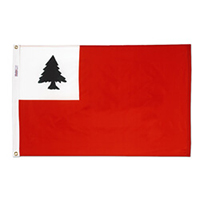 |
Continental Flag
Colonel John Trumbull's painting, "The Death of Warren," now at the Yale University Art Gallery, shows the red Continental Flag to be one of those used by American forces at the Battle of Bunker Hill, June 17, 1775. American troops rebuffed the British Regulars three times stopping the British charge. |
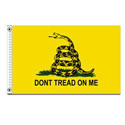 |
Gadsden Flag
Named after Colonel Christopher Gadsden of South Carolina, this flag was flown early in 1776 by Commodore Esek Hopkins of Rhode Island, first Commander-in-chief of the Continental Fleet. Its inscription represented a warning by the colonists to the British.Also knows as the Don't Tread on Me flag, the Gadsden flag is a popular symbol even today for freedom in the U.S. |
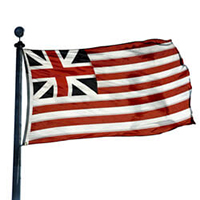 |
Grand Union Flag
Margaret Manny created the first (unofficial) national flag of the United States. The American colonists' first hoisted the Grand Union flag on the colonial warship USS Alfred, in the harbor on the western shore of the Delaware River at Philadelphia, Pennsylvania on December 3, 1775, by newly-appointed Lieutenant John Paul Jones of the formative Continental Navy. It was also raised in 1776 to celebrate the official status of the newly formed Continental Army by General George Washington, whose camp was in Cambridge. The flag is also known as the Cambridge flag or Continental colors. |
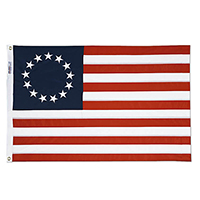 |
Betsy Ross Flag
The first official United States flag, adopted by an Act of Congress on June 14, 1777. According to legend, a group headed by George Washington commissioned Philadelphia seamstress Betsy Ross to execute their design for presentation to Congress. Though some historians dispute this legend Ross did indeed make flags, as evidenced by a receipt for the sum of more than 14 pounds paid to her on May 29, 1777, by the Pennsylvania State Navy Board for making “ships colours.” No official documentation has been found to confirm that Betsy Ross was responsible for creating the very first flag, but it is conceivable that Colonel George Ross—the uncle of Betsy’s recently deceased husband, John, recommended her for the job as a favor to his relative. |
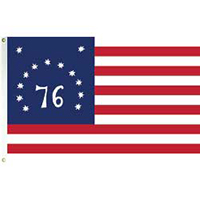 |
Bennington Flag
The Bennington flag is a version of the American flag associated with the American Revolution Battle of Bennington, from which it derives its name.Believed by many authorities to be the first Stars and Stripes used by American land troops. Flown over the military stores at Bennington on August 16, 1777 when General John Stark's militia led Americans to victory over British raiding force. The original flag is preserved in the Bennington, Vermont Museum. |
 |
Guilford Courthouse Flag
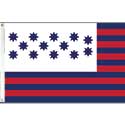
This unusual flag was made with thirteen 8-point stars in a wide field. Historical records report this flag carried by North Carolina militiamen at the Battle of Guilford Courthouse on March 17, 1781. The unique colors and dimensions are sometimes described as showing a lack of uniformity in a young nation at war, with a poor infrastructure and bad communication. However, it was common practice during the Revolution for military units to carry flags that featured common American symbols (such as stripes and stars), but to make them uniquely identifiable for use as a company or regimental flag. As such, this flag was probably never intended for use as a national flag. |
 |
Star Spangled Banner
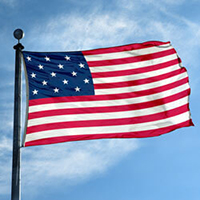
Shortly before the War of 1812, two new states were added to the Union and a flag consisting of 15 stars and 15 stripes was created. The Star Spangled Banner, flying over Fort McHenry during a British naval bombardment, inspired Francis Scott Key to compose what later becomes our National Anthem. This design, born with the Second Flag Act on January 13,1794, is our only official flag ever to have more than thirteen stripes. The badly damaged flag now hangs in the Smithsonian but the damage was not all from the bombardment of Ft. McHenry. Learn more at The Star-Spangled Banner website from the Smithsonian. |
 |
Confederate Battle "Jack" Flag
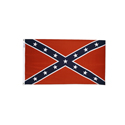
The "Jack" was the flag of the Confederate Navy. It is a rectangular rather than square flag and omits the thin white border around the outside. This flag was used mainly by the Confederate Navy but also by some ground troops. Some historians say that the battle flag was adopted because during the first contest of the Civil War troops became confused by the Stars and Bars and the Union flag looking similar in the fog of war. It is said many "friendly fire" incidents occurred due to the flag's similarities. |
 |
Bonnie Blue Flag
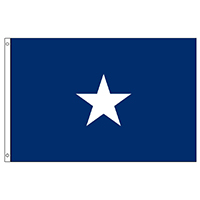
On September 23, 1810 Florida dragoons raised their Bonnie Blue flag over the Fort of Baton Rouge after its capture. Three days later the president of the West Florida Convention, signed a Declaration of Independence and the flag became the emblem of a new republic. With this rebellion in mind, this flag was used by the Republic of Texas from 1836 to 1839. On January 9, 1861 the convention of the People of Mississippi adopted an Ordinance of Secession. With this announcement the Bonnie Blue flag was raised over the capitol in Jackson. The Confederate government did not adopt this flag but the people did and the lone star flags were adopted in some form in five of the southern States that adopted new flags in 1861. |
 |
Stars and Bars Flag
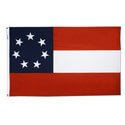
The first flag of the Confederacy. Although less well known than the Confederate Battle Flag, the Stars and Bars was used as the official flag of the confederacy from March 1861 until May 1863. The first iteration shown here has 7 stars representing the first 7 states to join the Confederacy. By 1863 the Stars and Bars had as few as 4 stars and as many as 17 stars. |
 |
Second National Confederate Flag
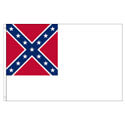
Adopted on May 1, 1863 this flag displays the Battle Flag or "Southern Cross" on the canton. The white field is symbolic for the purity of the cause which it represented.This second design was sometimes called "the Stainless Banner" and is sometimes referred to as the "Stonewall Jackson Flag" because its first use was to cover Stonewall Jackson's coffin at his funeral. The nickname "stainless" referred to the pure white field. This design was also used as the Confederate Naval Ensign between 1863-1865. The original flag is now on display in the Museum of the Confederacy in Richmond, Virginia. |
 |
Third National Confederate Flag
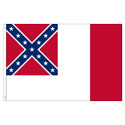
Due to the fact that the 2nd National's pure white field could be mistaken for a flag of surrender, on March 4, 1865 this last flag of the Confederacy was adopted. This design added a red bar to the end of the "Stainless" flag. This flag flew for thirty-six days in 1865 until the South surrendered on April 9th. Despite the short life the flag was reported in Richmond newspapers in December of 1864 and by January of 1865, and were flying over Richmond hospitals and units of the James River Squadron. |
 |
General Lee's Headquarters Flag
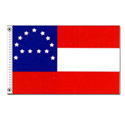
This version of the Confederate Flag, with its unusual 13 star arrangement, was adopted by General Lee for use at his headquarters. The unusual star arrangement is believed to have been designed by his wife Mary to reflect the Biblical Arch of the Covenant. According to legend this flag was actually hand-made by Mary Custis and their daughters. The General's original flag is on display at the Museum of the Confederacy in Richmond, Virginia. |
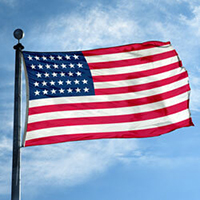 |
Civil War Flag (34 Stars)
During the Civil War period, the Union forces used four official flags... the 33, 34, 35 and 36 star U.S. flag. The 34 star U.S. flag was one of the flags flown most extensively during this time in our nation's history. From 1861 to 1863, it was the official flag of the United States. |
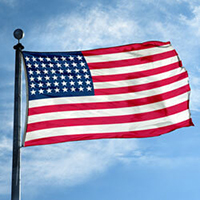 |
Old Glory (48 Stars) Flag -WW II
On July 4, 1912, the U.S. flag grew to 48 stars. This flag was official for 47 years, through two World Wars and the emergence of the United States of America as the leading nation of the world. No two incidents better reflects the courage and valor of those who fought and died than the raising of the 48 star flag over Mount Suribachi. This dramatic scene occurred on Iwo Jima in 1945 and is replicated forever as a statue near Washington, DC. This flag also flew on all U.S. warships during the battle of Pearl Harbor. |
| You can find some of these Historical U.S. flags and others in our Historical Flags shop. |
(return to top)
U.S. State Flags
All the States in the Union have their own flags. The designs are varied; many place the State Seal on a blue field, and a few have different emblems on the two sides. Some in the southern states show the influence of the Civil War; others, formed out of the Louisiana Purchase, that of France; and others, that of European heraldry or the symbolism of native American peoples.
 |
Alabama Flag
In spite of its color, the flag of Alabama is officially described as "a crimson cross of St. Andrew on a white field", is said to be based on the Confederate Battle Flag. |
 |
Alaska Flag
Designed by a schoolboy, the flag of Alaska is simple but effective. Appropriately for so northerly a region, it displays the Great Bear constellation and the Poles Star. |
 |
Arizona Flag
The flag of Arizona, formerly that of the battleship named after the State, depicts the copper-colored Star of Arizona before the setting sun. It combines the state colors with those of Imperial Spain. |
 |
Arkansas Flag
The white stars on the blue border to the white lozenge on the flag of Arkansas indicate that it is the Twenty-fifth State in the Union. The three stars below the name symbolize the three nations to which the region has belonged, Spain, France and the United States of America; that above the name commemorates the Confederacy. |
 |
California Flag
The Bear Flag of California, dating from the time of the Western Pioneers, recalls the State's former existence as an independent republic. |
 |
Colorado Flag
The initial letter on the flag of Colorado surrounds a gold disc representing sunshine; the tricolor symbolizes the blue skies and the snow-capped mountains. |
 |
Connecticut Flag
The State Seal on the light blue flag of Connecticut, an ornate gold-bordered shield displaying three grapevines, symbolizes the three original colonies which formed the state motto, from the States colonial banner, is Qui Transtulit Sustenit ("He who brought us over sustains us"). |
 |
Delaware Flag
The buff diamond on the blue flag of Delaware bears the State Coat- of - Arms; the buff color may be derived from the insignia of the Netherlands, by whose people the region was colonized. |
 |
Florida Flag
The flag of Florida resembles that of Alabama but at its center is a reproduction of the State Seal. Prominent in the landscape, which it depicts, is an Indian woman scattering flowers, in reference to the State's name; the motto is "In God We Trust". |
 |
Georgia Flag
The flag of Georgia prominently displays the Battle Flag of the confederacy. The broad blue stripe in the hoist bears a replica of the State Seal, on which three pillars engraved "Wisdom, Justice, Moderation", for the legislative, judicial and executive branches of government, support an arch inscribed "Constitution". |
 |
Hawaii Flag
The canton of the flag of Hawaii is formed by the British Union flag, thus recalling the discovery of the islands by Captain James Cook in 1778. In 1898 they were formally annexed by the United States. The white red and blue stripes in the fly represent the eight islands in the group. |
 |
Idaho Flag
The State Coat-of Arms of Idaho includes a shield showing the sun rising over the mountains; the supporters are a woman with a spear and a pair of scales and wearing the cap of liberty, and a miner with a pick; the crest is a moose's head and the motto Esto Perpetua "May she endure forever". |
 |
Illinois Flag
The flag of Illinois displays an eagle with a shield perched on a rock and a sun rising above the sea. In the eagle's beak is a scroll with the motto "State Sovereignty, National Union". The word Illinois appears below the badge. |
 |
Indiana Flag
The gold torch depicted on the flag of Indiana symbolizes liberty and enlightenment. The stars surrounding it represent the original thirteen States; the five below the torch represent those which joined the Union before Indiana, and the large star is for Indiana itself - the nineteenth State to be admitted to the Union. |
 |
Iowa Flag
The flag of Iowa, a state formed out of the Louisiana purchase, is adapted from the French tricolor: on the broad central stripe is depicted a flying eagle bearing a scroll inscribed "Our liberties we prize and our rights we will maintain". |
 |
Kansas Flag
The seal of Kansas is shown surmounted by the State's floral emblem, the sunflower. In the landscape which it depicts, the ploughman represents agriculture and the herd of buffaloes pursued by mounted Indians, like the "prairie schooners" (covered wagons), recalls the state's history. The stars show that it was the thirty-fourth State to enter the Union, and the motto is Ad Astra per Aspera ("Through difficulties to the stars"). The word "Kansas" appears below the seal. |
 |
Kentucky Flag
On the State Seal of Kentucky, reproduced on the flag, two men are shown shaking hands as though to illustrate the motto, "United we stand, divided we fall". The wreath below the seal is formed of the State's flower, the goldenrod. |
 |
Louisiana Flag
The emblem of Louisiana, white on a blue field is the traditional symbol of devotion, a pelican feeding its young. A scroll below bears the words "Union, Justice, and Confidence". |
 |
Maine Flag
The Coat- of-Arms of Maine appears on a blue flag. The shield depicts a moose lying at the foot of a pine tree. The supporters are, a farmer with his scythe and a seaman with his anchor; above appears the North Star with the word Dirigo ("I direct"). |
 |
Maryland Flag
The heraldic device on the quartered flag of Maryland dates from the founding of the colony early in the seventeenth century. It depicts the arms of Lord Baltimore, the colony's founder, quartering the Arms of his father (Calvert) with those of his mother (Crossland). |
 |
Massachusetts Flag
The State Seal shown on the white flag of Massachusetts displays all in gold on a blue field, a star beside which stands a Red Indian armed with bow and arrow. The crest is an arm brandishing a sword, and the motto is Ense Petit Placidam sub Libertate Quietem ("With the sword she seeks peace under liberty"). The State's Maritime Flag depicts the traditional green pine tree on a white field. |
 |
Michigan Flag
The word Tuebor ("I will defend") on the Coat-of-Arms shown on the flag of Michigan refers to the State's position on the Canadian Frontier; the device shows a man standing on a headland lit by the rising sun. The supporters are an elk and a moose, and the American eagle and motto form the crest. A scroll below bears the command Si Quaris Peninsulam Amoenam Circumspice ("If you seek a beautiful peninsula, look around you"). |
 |
Minnesota Flag
On the flag of Minnesota the State Seal is shown on a deep blue field. The device, a white farmer watching an Indian horseman riding westwards, refers to the spread of civilization. The nineteen stars show that this was the nineteenth State, after the original thirteen, to be admitted to the Union. They arranged to form a larger star symbolizing Minnesota as the "North Star State", as is expressed by the words L' Etoile du Nord. That typical prairie animal, the gopher, surmounts the staff. |
 |
Mississippi Flag
The Confederacy is recalled not only in the Battle Flag, which forms the canton of the flag of Mississippi, but also in the tricolor fly, which suggests the Stars and Bars. The colors are however blue, white and red, possibly recalling the Louisiana Purchase. |
 |
Missouri Flag
The Louisiana Purchase may also be responsible for the tricolor flag of Missouri. This bears a replica of the State Seal, surrounded by a circle of stars which indicate that the State was the twenty-fourth to join the Union. The two mottoes read "United we stand, divided we fall" and Salus Populi Suprema Lex Esto ("The welfare of people is the supreme law"). |
 |
Montana Flag
The State Seal on the blue flag of Montana depicts the sun setting behind mountains overlooking the Great Falls of the Missouri; in the fore ground are a plough and a miner's pick and shovel. The words Oro y Plata ("Gold and silver") refer to the State's mineral wealth. This flag resembles that carried by the Montana Infantry in the Spanish-American War. |
 |
Nebraska Flag
The State Seal of Nebraska shows a steamboat ascending the Missouri River, a train steaming towards the Rockies, and - to represent the mechanical arts and agriculture - a blacksmith and a settler's cabin. The motto is "Equality before the law". |
 |
New Hampshire Flag
The Sate Seal of New Hampshire is encircled by a wreath of laurel interspersed with stars. It depicts the frigate Rawleigh, one of the first vessels in the American Navy. |
 |
New Jersey Flag
The buff color of the flag of New Jersey is that of the facing of the State troops during the War of Independence, and is said to have been chosen by George Washington because it figured in the insignia of the Netherlands. The flag depicts the State Coat- of - Arms; the supporters are female figures bearing respectively a Cap of Liberty and a cornucopia, refer to the motto "Liberty and Prosperity". |
 |
New Mexico Flag
On the yellow flag of New Mexico the ancient Zia Sun-symbol of the Zuni Indians appears in red; these are the colors of Old Spain, which once ruled this region. |
 |
New York Flag
The flag of New York State boldly displays its Coat-of-Arms. The shield depicts a sloop and a ship under sail on the Hudson River; The crest is an eagle perched on part of the terrestrial globe showing the North Atlantic; the supporters are female figures representing Liberty and Justice, and the motto, Excelsior, hardly needs explanation.
The design of the civic flag of the city of New York- originally called the "New Amsterdam"- commemorates the city's early history as a Dutch colony. A vertical tricolor, it bears in reverse the historic colors of the Netherlands, orange, white and blue. On the central stripe appears the city's seal. A saltire formed by the arms of windmill quarters two beavers with two flour barrels, symbolizing New Amsterdam's chief articles of merchandise, fur and food. The crest resembles that of New York State, the supporters are, a seaman holding navigational instruments and a Red Indian holding a bow. The motto is Sigillum Civitatis Novi Eboraci ("The seal of the City of New York").
|
 |
North Carolina Flag
The flag of North Carolina recalls in its red and white fly the influence of the Stars and Bars; the dates on the royal blue stripe in the hoist are those of events significant in the State's history. |
 |
North Dakota Flag
The design on the blue flag of North Dakota, which includes the American eagle, the national motto, the thirteen white stars and the shield striped red and white, is based on that of the Regimental colors of the first North Dakota Infantry in the Spanish-American War and the Philippine Insurrection. |
 |
Ohio Flag
The State of Ohio flies not the usual rectangular flag but a tapering burgee of the national colors. The stars indicate that this was the seventeenth State to join the Union, and the red circle with the white border suggest both the State's initial letter and its unofficial name, the "Buckeye State". |
 |
Oklahoma Flag
The device on the light blue flag of Oklahoma depicts an Indian warrior's rawhide shield, from which hang seven eagle's feathers. Upon the shield are crossed another Indian emblem, the calumet (pipe of peace), and the classical symbol of peace, the olive branch. |
 |
Oregon Flag
On the obverse of the flag of Oregon appears the shield from the State's Coat-of-Arms: It depicts a covered wagon on the shore of the Pacific Ocean, on which a British man-o'war is departing and an American ship arriving. Below a scroll bearing the words "The Union", a sheaf, a plough, and a pickaxe. The Crest is and American Eagle. On the reverse of the flag is portrayed a golden beaver. |
 |
Pennsylvania Flag
The State Coat-of-Arm appears on the flag of Pennsylvania. The shield depicts a ship at sea, a plough, and three wheat sheaves; the supporters are horses in harness and the crest is an eagle; the motto reads "Virtue, Liberty and Independence. |
 |
Rhode Island Flag
The golden anchor displayed on the white flag of Rhode Island is the traditional symbol of hope; the thirteen gold stars represent the original States of the Union. |
 |
South Carolina Flag
The flag of South Carolina is based on what is traditionally the first American flag displayed in the Southern States during the War of Independence. The Moultrie Flag, blue with a white crescent moon in the upper hoist; the white palm-tree was added when the State seceded at the beginning of the Civil War. |
 |
South Dakota Flag
South Dakota adopted a new flag in 1963. It has a sky-blue field with the Great Seal of South Dakota in the center; this seal can have either a white of sky-blue background, and is outlined in dark blue. Around the edge are a serrated sun and the words "South Dakota" and "The Sunshine State". |
 |
Tennessee Flag
The flag of Tennessee displays the national colors: the three stars represent the three regions created by the Tennessee River - West, Middle and East. |
 |
Texas Flag
The flag of Texas is that used during the State's independence. Its general design almost suggests that the Stars and Bars were derived from it, but the resemblance may be coincidental. The emblem in the Hoist typified the "Lone Star State". |
 |
Utah Flag
Surrounded by a narrow gold ring, the State Seal appears on the flag of Utah. The shield displays a beehive, the emblem of industry, and the State's flower, the sego lily. The crest is the American Eagle, two American Flags replace the usual supporters. The dates are those on which the State was founded by the Mormons, who called it I (Land of the HoneyBee), and of its admission to the Union. |
 |
Vermont Flag
The flag of Vermont shows the State's coat-of-Arms. The landscape depicted on the shield includes a pine-tree, three wheat sheaves and a red cow, with a mountain range in the background. The motto is "Freedom and Unity". |
 |
Virginia Flag
The State Seal depicted on the blue flag of Virginia dates almost to the Declaration of Independence. It shows Virtue, dressed like an Amazon and armed with sword and spear, trampling down the figure of Tyranny, whose crown is fallen and who grasps a broken chain and a whip. The motto is Sic Semper Tyrannis ("Thus ever to Tyrants"). |
 |
Washington Flag
The green flag of the State of Washington bears a replica of the State Seal. Within a gold circle appears the head and shoulders of George Washington, after whom the State was named. |
 |
West Virginia Flag
The white blue-bordered flag of West Virginia shows the State's Coat-of-Arms. The shield depicts a rock beside which stand a farmer and a miner with implements symbolizing the clearing of the forest, agriculture, and the mechanical arts. The Cap of Liberty surmounts two crossed rifles. The motto is Montani Semper Liberi ("Mountaineers always free"). |
 |
Wisconsin Flag
The State Coat-of-Arms appears on the square flag of Wisconsin. The shield quarters a plough, a crossed shovel and pick, an arm brandishing a hammer, and an anchor. The supporters are a seaman and a laborer, the crest is the State animal, a beaver, and the motto is "Forward". |
 |
Wyoming Flag
The flag of Wyoming displays the national colors and bears in white the silhouette of a buffalo; on its side appears the State Seal. |
Other U.S. Flags
Based on George Washington's Shield of Arms, which is doubtfully reputed to have influenced the design of the U.S. National Flag, the white flag of the District of Columbia depicts three red stars over two horizontal red stripes.
The dark blue flags of the Governors of the Panama Canal Zone and of Guam depict the respective Seals. That of Panama is a shield displaying a Spanish galleon sailing between two cliffs; above are thirteen white and red vertical stripes and below appears the motto "The land divided, the world united". The seal of Guam shows a coconut tree growing beside an estuary on which sails an outrigger canoe.
The white flag of the U.S. Virgin Islands displays the American Eagle between the two letters "V" and "I".
The flag of Puerto Rico was borne when its people of Cuba revolted against Spanish rule: five red and white horizontal stripes with a blue triangle displaying a white star in the hoist. The Governor's flag is white and bears a replica of the Island's seal.
The eagle displayed on the flag of American Samoa and representing the protection of the United States is shown as grasping two local symbols. The colors, blue with a white triangle surrounded by red, are also the colors of the United States.